PARCHED
PLANET
We Bring the Rain
Ending droughts without permission.
Making deserts green. Dipping from the atmosphere. Floating to the lake.
1,000 atmo-scoop ships. 1,000 dirigibles. No ground infrastructure required.
REWARD: Billions of Litres of Water & Renewed Hope
The Fleet
scroll
Artist’s impression — Speculāris atmospheric water delivery ship

A Planet Running Dry

Glaciers that fed rivers for ten thousand years are gone in decades. Aquifers that took millennia to fill are emptied in a generation. Snowpack that arrived every winter has stopped arriving. Two billion people face severe water stress today. Four billion face it at least one month per year. The diplomats are still in session. The aquifers cannot wait.

2B+
People — severe water stress
Right now. Not projected. Happening.
47
Countries in acute food crisis
266 million people. The drought is the fuse.
68%
Glacial mass lost by 2100
The rivers they feed will not recover on their own.
40%
Decline in global snowpack
Spring melt that fed agriculture for centuries is failing.

The ground-based solutions are too slow, too expensive, and require the cooperation of governments that have been disagreeing since 1972. Project Speculāris does not negotiate with geography.

1,000
Atmo-scoop ships
Low-pass atmospheric water capture. Each ship dips into moisture-laden air at 10km, scoops 10,000 tonnes per pass, and drops to the target zone. No orbital mechanics. No re-entry risk.
1,000
Graphene dirigibles
Iceberg-sourced ice containers lifted from Antarctic calving zones and floated inland on prevailing winds. 6–10 day transit. Zero propellant. Solar-powered navigation only.
10,000t
Per-ship payload
Atmospheric capture or ice block — either route delivers 10,000 tonnes to the target lake, snowpack zone, or aquifer recharge area per cycle.
0
Ground infrastructure required
No pipes. No pumping stations. No desalination plants. No brine waste. No coastal dependency. The sky is the infrastructure.

Two Fleets.
One Planet.
No Drought Survives.

The water programme operates two independent but complementary fleets. Fleet One dips into the atmosphere and drops directly. Fleet Two lifts ancient Antarctic ice and floats it inland. Together they deliver water to every parched coordinate on Earth — mountain snowpack, inland lakes, desert aquifer recharge zones, and failing rivers. No orbital mechanics. No re-entry. No ground infrastructure. Just water, falling where it is needed.
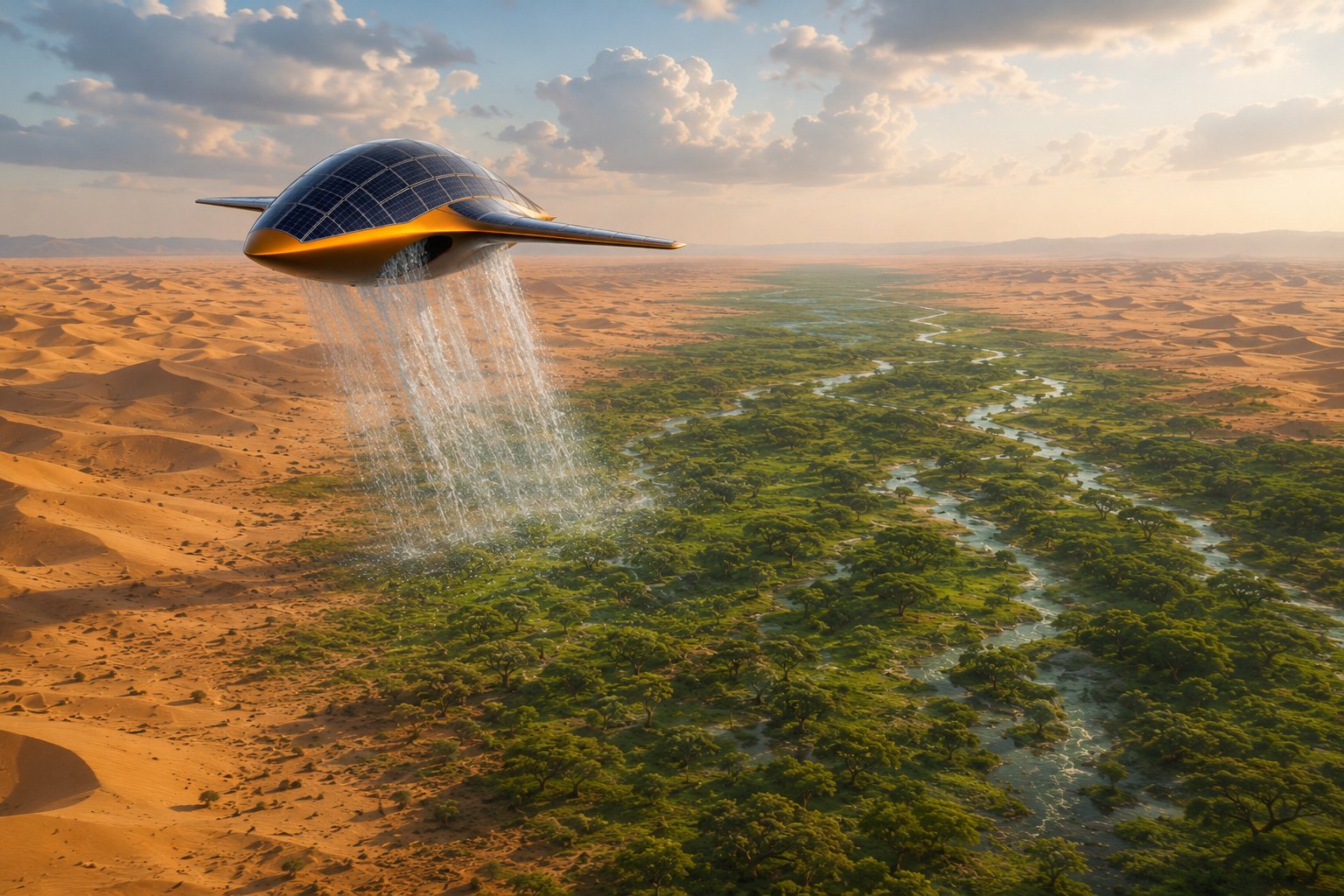
Atmo-scoop ship releasing captured water over a desert frontier, vegetation taking hold below
1,000
Fleet One — Atmo-Scoop Ships

Each ship operates at 10km altitude — the tropospheric moisture layer. Intake scoops harvest water vapour and liquid water from humid air masses. Onboard condensers accumulate a 10,000-tonne payload per cycle. DRAD-1 navigation. Fully autonomous. Drop altitude computed for orographic deposition — the water arrives as natural precipitation. No kinetic impact. No flood. A season's worth of rain, precisely placed.

10km
OPERATING ALTITUDE
10,000t
PER CYCLE
0
GROUND INFRASTRUCTURE
DRAD-1
AUTONOMOUS CONTROL
1,000
Fleet Two — Graphene Dirigibles

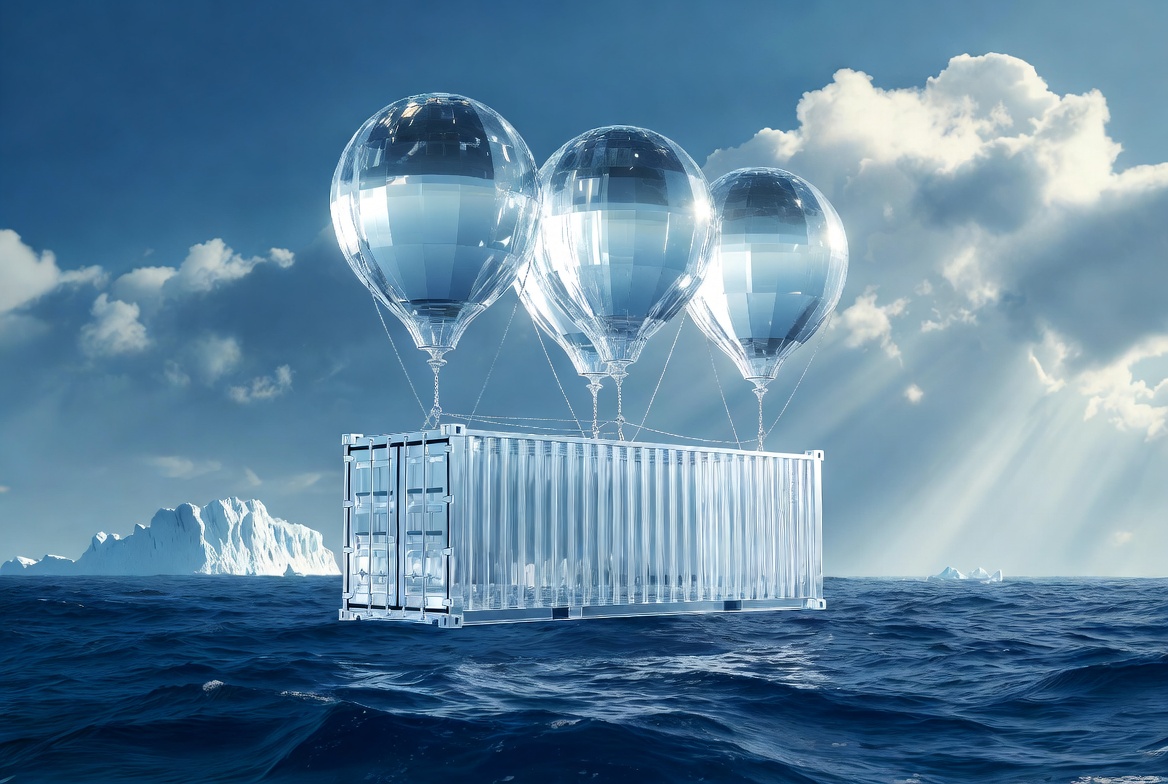
C5 Constructor drones anchor to calved Antarctic icebergs. Heated carbyne wire cutters slice ice blocks into insulated 28,000kg containers. Heavy-XXL 50m graphene dirigibles lift and transit inland on prevailing wind corridors — 6 to 10 days, zero propellant. Solar-powered DRAD-1 navigation steers each container to the target lake. The iceberg is already part of Earth's water inventory. The lake simply receives what the ocean was about to claim.
28,000kg
ICE PER CONTAINER
>90%
ICE RETAINED IN TRANSIT
6–10 days
TRANSIT TIME
0
PROPELLANT USED
Complementary Coverage
Fleet One covers high-altitude zones: Himalayan snowpack, Alpine glaciers, Andean headwaters, Sahara rainfall trigger zones. Fleet Two covers inland lakes and lowland agricultural aquifer recharge — Lake Mead, Chad, Poopó, the Aral basin. Each fleet does what the other cannot.
No Permission Required
No nation owns the sky at 10km. No government controls where rain falls. No treaty covers an iceberg already drifting to sea. Speculāris delivers water to a GPS coordinate. The water falls. The ground absorbs it. The vegetation follows. The paperwork can catch up.
Source: The Atmosphere Itself
Earth's atmosphere holds 12,900 km³ of water vapour at any moment — six times all the world's rivers combined. Fleet One does not create water. It relocates it. From where it is evaporating uselessly over the ocean to where it is desperately needed over a cracking lakebed.
Source: Antarctic Ice
Antarctica calves 2,000 km³ of ice per year — all of it bound for the ocean. Fleet Two intercepts the calving zone before the icebergs disperse. C5 Constructor drones cut, containerise, and hand off to the dirigible fleet. The ice that was going to raise sea levels instead refills Lake Mead.

Glaciers. Snowpack.
Rivers. Rain.

The hydrological cycle does not need to be repaired — it needs to be replenished. The Speculāris fleet targets the exact points in the system where the deficit is greatest.

🏔️
Glaciers
High-altitude atomization at sub-zero temperatures deposits material that compacts into ice under its own weight over seasons. Retreating glaciers in the Himalayas, Andes, Alps, and Hindu Kush receive targeted replenishment. The rivers they feed — the Ganges, the Indus, the Rhine, the Colorado — begin to recover.
❄️
Snowpack
Spring snowmelt feeds agriculture in the American West, Central Asia, and Northern China. Snowpack has declined 40% in critical regions. Orographic deposition via the Speculāris polar array restores the seasonal snowpack that irrigation systems and aquifer recharge depend on. The melt arrives. The crops grow. The aquifer refills.
🌊
Rivers
River flow is the downstream expression of upstream snowpack and glacial melt. Restore the source, restore the river. Targeted delivery to headwater zones recharges the rivers that feed irrigation systems, cities, and ecosystems. The Nile. The Murray-Darling. The Yellow River. The Colorado. All fed from the top.
🌧️
Rain
Desert margin precipitation triggers the albedo-vegetation feedback loop. More vegetation means more atmospheric moisture means more rain means more vegetation. The Speculāris fleet delivers the initial precipitation that starts the loop. The Sahara has been green before. It will be green again.
🌱
Aquifers
Surface precipitation percolates through soil into underground aquifer systems over months and years. Strategic delivery to aquifer recharge zones — where permeable geology allows rapid infiltration — rebuilds the groundwater reserves that support both agriculture and urban water supplies. Saudi fossil aquifers. The Ogallala. The Great Artesian Basin.
🌿
Sahara
The Sahara is not a permanent feature. Eleven countries. Nine million square kilometres. Once green. Becoming green again. Speculāris mirror augmentation, atmospheric water delivery, and CO₂ soil supplement work together to trigger the feedback loop. The desert margin advances. Then retreats. Then the Sahara does something it has not done in five thousand years.

How Water
Falls From Space

1
Fleet One — Atmospheric Capture
Atmo-scoop ships cruise at 10km altitude through moisture-laden air masses over tropical oceans and equatorial convergence zones. Intake scoops draw in humid air; onboard condensers accumulate a 10,000-tonne liquid water payload per cycle. The atmosphere provides the feedstock. The ship provides the bucket.
2
Fleet One — Dip and Drop
DRAD-1 navigation routes each ship to the target zone. Drop altitude is computed for orographic micro-droplet distribution — the payload is released as a fine mist that aerodynamically fragments on descent. No kinetic impact. No flood pulse. The snowpack receives a season's accumulation. The glacier does not know the water came from a machine.
3
Fleet Two — Antarctic Source
C5 Constructor drones anchor to calved Antarctic icebergs at the calving zone — before the ice disperses into the Southern Ocean. Heated carbyne wire cutters slice blocks into insulated 28,000kg containers. The iceberg is already part of Earth's water inventory. Speculāris simply intercepts it before the ocean claims it.
4
Fleet Two — Dirigible Transit
Heavy-XXL 50m graphene dirigibles lift each insulated container and ride prevailing wind corridors inland. 6 to 10 days transit. Zero propellant consumed. Solar-powered DRAD-1 navigation makes course corrections. Greater than 90% of the ice survives the transit in the insulated container. The target lake receives the delivery. The container returns south for the next load.
5
The Water Lands
Snowpack accumulates. Glaciers receive material. Inland lakes rise. Aquifer recharge zones receive surface precipitation. Desert margins receive the first meaningful rain in decades. The albedo-vegetation feedback loop begins. The green follows the water. The rain follows the green. The cycle is restored.

2,000 Vehicles.
Two Strategies.
One Result.

Fleet One operates where water is plentiful but misplaced — tropical ocean air masses, equatorial convergence zones, monsoonal moisture corridors. Fleet Two operates where water is solid and stranded — Antarctic calving fronts, glacial outflows bound for the ocean. Both deliver to where water is absent. The fleets are independent, non-competing, and together cover every drought scenario on Earth.

1,000
Atmo-scoop ships
1,000
Graphene dirigibles
10km
Fleet One altitude
6–10d
Fleet Two transit
0
Ground infrastructure

Fleet One targets high-altitude snowpack, glacier deposition, and desert-margin rainfall — precision micro-droplet release that mirrors natural orographic precipitation. Fleet Two targets inland lakes, lowland reservoirs, and agricultural basins — direct ice delivery to the lake surface, zero mechanical complexity at the destination. DRAD-1 runs both fleets. No human is present at any stage of the operation.

Speculāris Ice Delivery Programme — Antarctic Source · Dirigible Transport · Global Lakes
Speculāris ice delivery — graphene dirigibles lifting insulated container from Antarctic ocean with iceberg in background
Antarctic ice. Inland lake.
Zero fuel. Solar powered.
C5 CONSTRUCTOR DRONE · CARBYNE WIRE CUTTER · TIER 3 INSULATED CONTAINER · HEAVY-XXL 50m DIRIGIBLE
28,000 kg
ICE PER CONTAINER
>90%
ICE RETAINED
$2B
PER LAKE · ONE TIME

C5 Constructor drones anchor on calved Antarctic icebergs. Heated carbyne wire cutters slice ice blocks into insulated containers. Graphene dirigibles lift and transit to target lakes via prevailing winds — 6 to 10 days, zero propellant. The iceberg is already part of Earth's water inventory. The lake simply receives what the ocean was about to claim.

No Permission.
No Borders.
No Drought.

The water cycle does not respect national boundaries. Rain does not check a passport. Snow does not file for permits. Neither does the Speculāris fleet.

Thirty ships in polar orbit deliver precipitation to every parched coordinate on the surface of this planet. The Sahara. The Empty Quarter. The Atacama. The cracking riverbeds of California. The vanishing snowpack of the Hindu Kush. Every failing glacier. Every dry aquifer. Every empty reservoir.

We do not ask who owns the drought. We do not negotiate with the heat. We bring water from orbit and we put it where it is needed. The planet will be green again. We are merely accelerating the schedule.

The Rain Is
Coming.

Project Speculāris is the only program in existence that addresses water scarcity with two independent delivery fleets — 1,000 atmospheric scoop ships and 1,000 Antarctic ice dirigibles. Every drought zone on Earth.