C7 Tanker
The Workhorse
of the Network
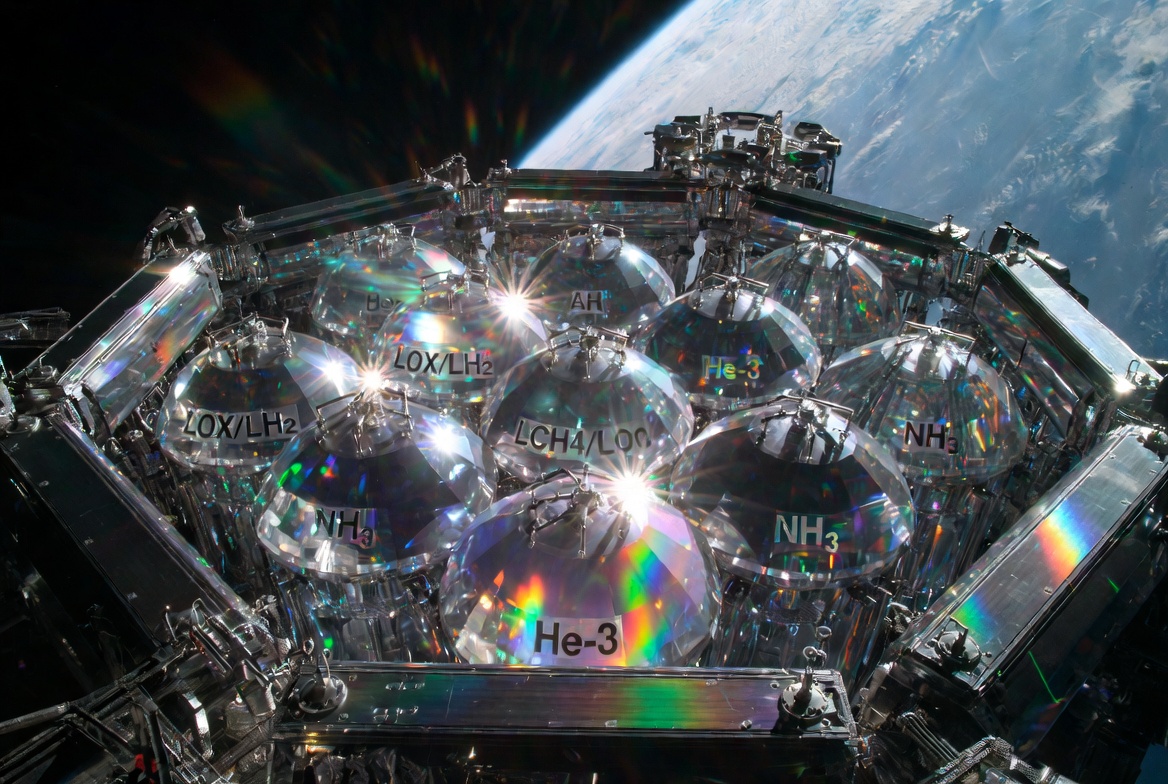
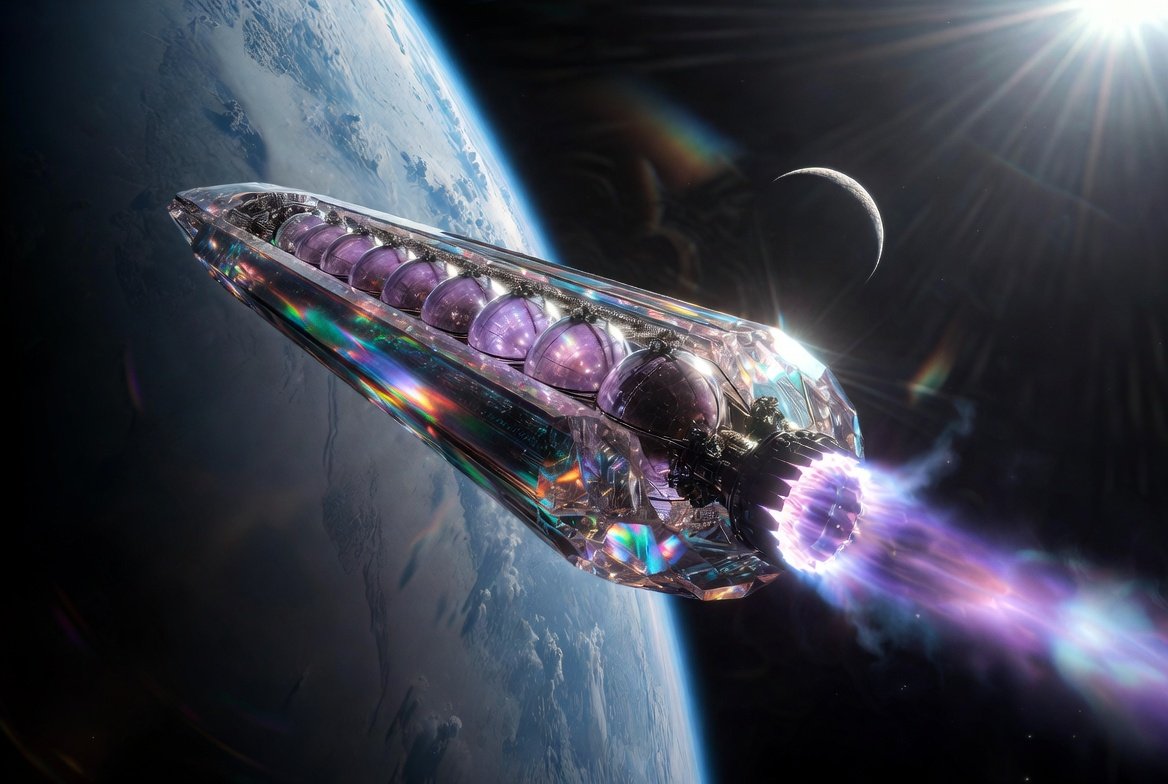
The C7 tanker class is the logistical backbone of Pro-pel. Factory-built at Earth-Sun L4 from asteroid-derived titanium and CNT composite structures. No Earth launch vehicle constraint on size or mass. No crew. Indefinitely reusable.
DRAD-1 manages all navigation, depot docking, propellant transfer, and return routing autonomously. The tanker never lands. It cycles between L4 and LEO continuously, maintaining depot inventory levels above minimum threshold at all times.
PropulsionHe-3/D Fusion Drive
NavigationDRAD-1 Autonomous
ConstructionAsteroid Iron + CNT Composite
CrewNone
Transit L4 → LEO3–5 Months
DockingAutomated — Both Depots
CargoAll Propellant Classes + He-3
ReusabilityIndefinite
Near-Term Product Line
Zero Additional Synthesis.
These products are byproducts or trivial derivatives of Pro-pel's existing operational processes.
No new chemical pathways required. Just collect, separate, and deliver.
GOX · GH₂
Gaseous
Oxygen + Hydrogen
Direct byproducts of water electrolysis — the same process that makes LH₂ and LOX.
Just don't liquefy.
GOX: satellite oxidizer, EVA support, industrial. GH₂: cold gas thrusters, fuel cells, industrial hydrogen.
Already produced continuously — marginal cost to collect and deliver.
GN₂ · LN₂
Gaseous + Liquid
Nitrogen
Factory N₂ surplus: 992 kg/day after all internal consumption.
GN₂: satellite cold gas attitude thrusters, pressurant for propellant tanks, inert purge.
LN₂: cryogenic coolant, propellant pressurisation.
Water ship atmospheric dip (78% N₂) provides continuous free supply. Already delivered as Pro-pel Tank 4 pressurant.
LCO₂
Liquid
Carbon Dioxide
Straight from the cold trap volatile separation stream.
Already separated — just collect and deliver.
CO₂ pressurant for propellant systems, cold gas thruster propellant, supercritical CO₂ Brayton cycle working fluid, industrial uses. ARP atmospheric remediation programme produces surplus CO₂ as a captive stream.
H₂O₂ · HTP
High-Test
Peroxide
Electrochemical synthesis from asteroid water — one step from water and electricity.
90%+ concentration HTP is a viable monopropellant and standalone thruster propellant used in satellite attitude control.
Also the key intermediate for hydrazine Raschig synthesis. Dual-use: propellant product and hypergolic feedstock.
N₂O
Nitrous
Oxide
Synthesis: NH₃ + O₂ at lower temperature than the Ostwald process → N₂O.
One step from ammonia, which is already a Pro-pel product.
Used in hybrid rocket motors (SpaceShipOne/Two used N₂O/rubber), satellite thrusters, and as a self-pressurising oxidizer. Growing market in new commercial launch vehicles.
D₂O · D₂
Deuterium
Water + Gas
Factory produces 10,880g deuterium per day surplus after all FPP drive consumption.
D₂O: fusion reactor research, neutron moderation, isotope chemistry.
D₂: fusion fuel partner with He-3 for FPP drives — supplied to fusion propulsion customers alongside He-3 for a complete fusion fuel package.
Available via Pro-pel Tank 6 (proposed small D₂O vessel alongside He-3 Tank 5).
Extended Product Line — Coming Soon
Hypergolic Propellants.
All hypergolic propellants trace back to ammonia as a primary feedstock — and Pro-pel already makes ammonia at L4 via Haber-Bosch.
The downstream synthesis pathways are fully mapped. Production follows factory maturation.
Legacy hypergolic fleets currently launch with a full lifetime propellant load. Pro-pel hypergolics enable on-orbit life extension for the first time from a non-terrestrial supply chain.
Hydrazine · N₂H₄
Hydrazine
Monopropellant and hypergolic fuel. Used in satellite attitude control, spacecraft thrusters, and upper stages.
Synthesis at L4: NH₃ + H₂O₂ → N₂H₄ + H₂O (Raschig process).
H₂O₂ produced by electrochemical synthesis from asteroid water. NH₃ from Haber-Bosch. All feedstocks present at L4.
Coming Soon
MMH · CH₃N₂H₃
Monomethyl
Hydrazine
Primary fuel in MMH/NTO bipropellant systems. Used in most GEO satellites, the ISS, and many spacecraft.
Synthesis: CO + 2H₂ → CH₃OH (methanol, Sabatier-adjacent) → methylamine → MMH + N₂H₄.
CO and H₂ from asteroid cold trap and electrolysis. Multi-step but all feedstocks at L4.
Coming Soon
NTO · N₂O₄
Nitrogen
Tetroxide
Oxidizer for MMH/NTO systems. Hypergolic on contact with MMH — no ignition required.
Synthesis: Ostwald process — NH₃ → NO → NO₂ → N₂O₄.
Platinum catalyst (present in metallic asteroids) required for catalytic NH₃ oxidation. All feedstocks and catalysts available at L4.
Coming Soon
UDMH · C₂H₈N₂
Unsymmetrical
Dimethylhydrazine
Used in Ariane, Proton, Long March, and many legacy launch vehicles paired with NTO.
Synthesis: N₂H₄ + 2CH₃OH → UDMH (via dimethylamine pathway).
Both hydrazine and methanol already produced at L4 in prior synthesis steps. UDMH is a downstream product once those lines are established.
Coming Soon
Supply chain note:
All hypergolic propellants trace back to ammonia (NH₃), which Pro-pel produces at L4 via Haber-Bosch
using nitrogen captured free from Earth's atmosphere by the water ship dip fleet (78% N₂) and hydrogen from asteroid water electrolysis.
Platinum-group catalysts required for Ostwald process are present in metallic asteroid feedstock.
No Earth-derived chemical inputs required at any synthesis stage.
Timeline: hypergolic product lines follow factory chemical processing module maturation.
Current Pro-pel products (LH₂/LOX, LCH₄/LOX, NH₃, He-3) are operational from Month 14.5 onward.
Cryogenic Delivery System
Cold to Destination.
Pro-pel cryogenic containers maintain propellant temperature from L4 through mass driver launch, transit, and depot transfer — without active refrigeration.
The container is the cold chain. No power required.
Container Layer Stack
Outer Shell
White paint · solar reflectance 0.85
Reflects solar input before reaching thermal layers. Container orientation-independent — no shadow routing required.
PRO-PEL LOGO
CNT Emissivity Layer
Carbon nanotube coating · emissivity 0.99
Radiates heat directly to 3K deep space. Near-perfect black body. Passive — zero power, zero maintenance.
Silver Fluid Carrier
Silver tube wound on exterior · closed loop
Pre-cooled fluid from shadow pipe circuit. Pulls any residual heat from vessel wall. Fluid never contacts propellant.
Inner Vessel
Glass-lined steel · IBCX standard
LOX · LH₂ · LCH₄ · LN₂ · He-3 — all propellant classes. Standard ISO fittings. DRAD-1 fill monitoring.
Performance
0.99
CNT emissivity — near perfect black body
0.85
White shell solar reflectance
3K
Deep space cold sink temperature
Any
Orbital orientation — no shadow required
Zero
Active refrigeration power required
ISO
Standard fittings — any depot compatible
How the cold chain works
At L4 the factory pre-cools propellant gases through permanently shadowed CNT-coated pipe runs — hydrogen reaches approximately −200°C before the final liquefaction stage. The filled container is wrapped with CNT emissivity coating and a silver fluid carrier circuit, enclosed in the white outer shell.
Once sealed, the container maintains cryogenic temperature indefinitely through passive radiation to 3K space, regardless of solar exposure.
Through mass driver launch, transit to depot, and final customer transfer — the propellant stays cold. The container is the refrigerator.
Pro-Pel branded container
Every Pro-pel container arrives white — the Pro-Pel logo visible from any approaching spacecraft.
The white outer shell is not cosmetic — it is the first thermal protection layer.
Solar reflectance 0.85 means the container rejects sunlight before it reaches the CNT insulation layer. The brand and the engineering are the same surface.
Container-compatible propellant classes
LH₂ −253°C
LOX −183°C
LCH₄ −162°C
LN₂ −196°C
He-3 −270°C
NH₃ −33°C
N₂H₄ hypergolic
NTO −11°C