☽   Lunar South Pole · Shackleton Crater · Solar Wind Implanted   ☽

HE3

The Fuel of the Fusion Age
8 kg
Global supply / year (current)
37.2 kg
Speculāris Year 1 production
×2
Fleet doubles every 6 months
Month 17
First delivery from L4 arrival

Helium-3 is the cleanest fusion fuel in existence. The D/He-3 reaction produces no neutrons — only charged particles. No radioactive waste. No reactor contamination. Direct energy conversion at 80% efficiency. The entire current global supply is 8 kilograms per year, rationed from US government nuclear weapons tritium decay. Speculāris harvests it from the lunar regolith and delivers it to Earth orbit from Month 17.

scroll
The Supply Crisis

The Most Valuable
Substance on Earth

Helium-3 is almost entirely absent from Earth's atmosphere — it escapes to space over geological time because it is lighter than air. The only terrestrial source is the decay of tritium in nuclear warheads. The United States Department of Energy produces approximately 8 kilograms per year. It is quota-limited, politically controlled, and insufficient for any meaningful fusion research programme, let alone a commercial fusion energy industry.

8 kg
Global production — per year
US DOE tritium decay. The entire world's He-3 supply. Quota-limited. Politically controlled.
$1,400
Per litre — current market price
When available. Most research programmes simply cannot obtain adequate supply regardless of price.
0
Commercial He-3 suppliers — worldwide
No commercial market. No free market pricing. No supply chain. Government rationing only.
1M kg
Lunar regolith He-3 estimate
4.6 billion years of solar wind implantation. The lunar regolith is a reservoir of He-3 that dwarfs all terrestrial sources by a factor of 100,000.

The fusion research programmes at QST, NIFS, ITER, and university plasma labs worldwide are not limited by funding, engineering, or physics. They are limited by He-3 supply. ITER uses deuterium-tritium precisely because DT has a lower ignition threshold than D/He-3 — not because it is better physics. The only reason humanity is not pursuing the cleaner, more efficient D/He-3 cycle at scale is that there is no He-3. Until now.

The Physics

Why He-3 Is
the Right Fuel

D + ³He ⁴He (3.6 MeV) + p (14.7 MeV) + 18.3 MeV total
NEUTRON OUTPUT
Near zero from the primary reaction. No radioactive activation of reactor walls. No tritium breeding blanket required. No long-lived radioactive waste stream.
ENERGY FORM
Reaction products are entirely charged particles — He-4 nucleus and a proton. Charged particles are directly convertible via MHD without a thermal cycle. 80% conversion efficiency versus 35% for DT thermal plant.
ENERGY PER REACTION
18.3 MeV per D/He-3 event. 14.7 MeV carried by the high-energy proton alone. The Speculāris FPP-1 and FPP-2 drives are both designed specifically for D/He-3 fuel.
PLANT LIFETIME
No neutron activation means structural components do not become radioactive over time. Plant lifetime is limited by mechanical wear only — not radiation damage to the vessel. Decommissioning cost approaches zero.

D/He-3 vs Other Fusion Fuels

Fuel cycleNeutron outputRadioactive wasteConversion efficiencyFuel availability
D-T (Deuterium-Tritium)
Current ITER standard
80% neutrons High — activated walls, tritium ~35% thermal Tritium must be bred
D-D (Deuterium-Deuterium)
~50% neutrons Moderate ~35% thermal Abundant — seawater
p-B11 (Proton-Boron)
Near zero Minimal ~60% direct Boron abundant
D-He3 (Speculāris)
FPP-1 and FPP-2 design fuel
Near zero Negligible ~80% direct MHD Lunar harvest — unlimited
The LH-1 Harvester

Autonomous Lunar
He-3 Harvester

The LH-1 is an autonomous bulldozer that scrapes lunar regolith, heats it to release solar-wind-implanted He-3, and stores it for collection. It is manufactured entirely at L4 from asteroid-derived materials. It requires no Earth launch after the initial seed ship. It is delivered to the Moon by fusion ship and is self-fueling after an initial bootstrap charge from the L4 factory.
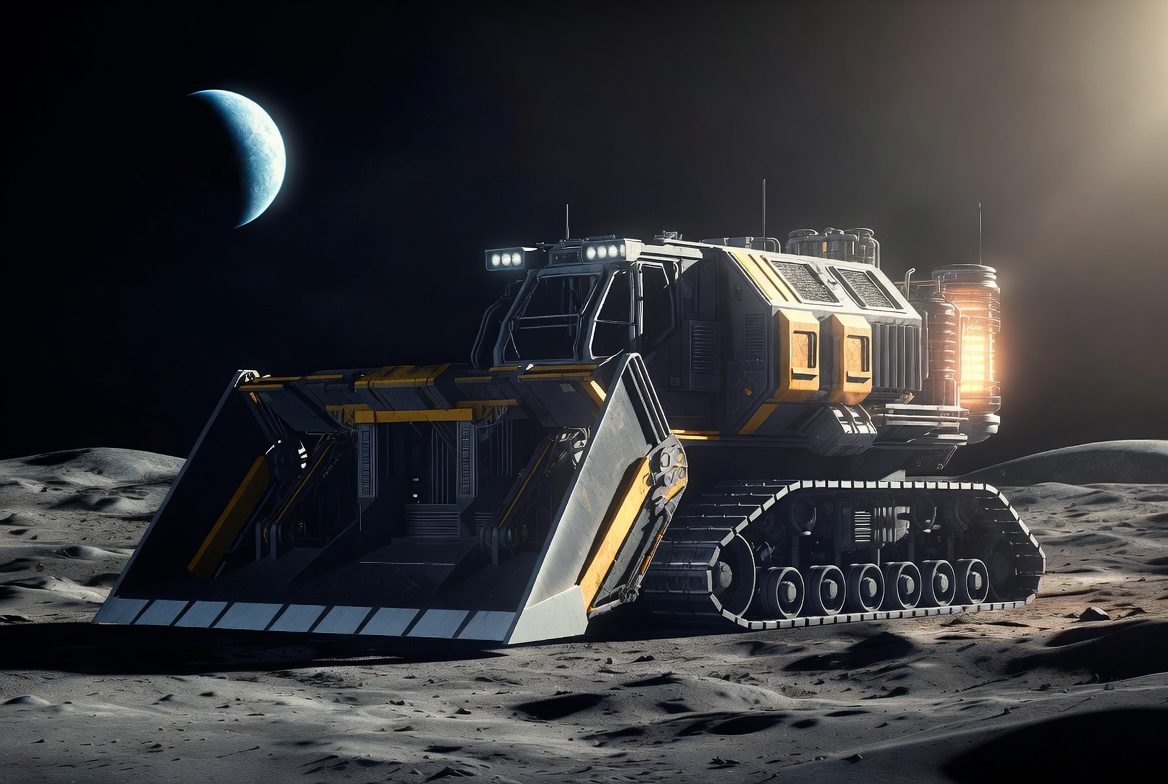
LH-1 Autonomous Lunar He-3 Harvester on the lunar surface
🌙
Regolith Scraping
Bulldozer blade geometry designed for lunar regolith mechanics. Shackleton crater rim and adjacent highlands — highest He-3 concentration zones identified by C1 Scout spectral mapping. DRAD-1 autonomous navigation. No human operator. No communications delay limitation. The LH-1 decides its own route based on real-time regolith spectrometer readings.
🔥
Thermal Extraction
Solar-wind He-3 is implanted at depths of ~100nm in regolith grain surfaces. Heating the regolith to ~700°C releases it. LH-1 uses a concentrated solar thermal collector — the same mirror array technology as the L4 factory, miniaturised. Zero propellant consumed in the extraction process. The Sun provides the extraction energy free of charge.
⚗️
Isotope Separation
Released gas is a mixture of He-3, He-4, hydrogen, and trace volatiles. Cryogenic separation — He-3 boiling point 3.19 K, He-4 boiling point 4.22 K — isolates He-3 to research-grade purity. The DRAD-1 controlled cryogenic separator is the most critical precision component in the system. He-4 byproduct stored separately — commercially valuable.
🛸
Self-Fueling After Bootstrap
The LH-1 retains a fraction of its He-3 harvest as propellant for its own FPP micro-drive. After the initial bootstrap charge from the L4 factory, the harvester is energetically self-sufficient. The machine that collects He-3 runs on He-3. Each additional machine deployed doubles the fleet capacity from its own harvest — no additional Earth launch required.
🏭
L4 Manufactured
Structural frame: asteroid steel. Electronics: DRAD-1. Cutting blade: carbyne composite. Solar collector: Mylar mirror panel. Cryogenic separator: CVD diamond / graphene thermal management. Not one component requires an Earth launch after the seed ship. C5 Constructor drones at L4 build each unit to specification.
📦
Container Delivery to Earth
Filled He-3 containers transfer from Shackleton to lunar orbit via C4 Transport drone. Transfer to reentry capsule. Ocean drop to customer EEZ coordinates. JMSDF or coast guard recovery. No port infrastructure required. Chain-of-custody RFID tracked from lunar surface to customer receipt.

The Shackleton Crater connection: The lunar south pole experiences near-continuous solar illumination — up to 89% of the year at the crater rim. This is both the solar power source for the LH-1 and the reason He-3 concentrations are highest here — maximum solar wind exposure over geological time. The same geography that makes Shackleton ideal for a permanent lunar base makes it ideal for He-3 harvesting. The LH-1 fleet and the Shackleton data centre (20 floor nodes + 10 rim nodes, built by two permanently assigned Constructor drones) share the same location.

Production Roadmap

From 37 kg
to Tonnes Per Year

The LH-1 fleet scales exponentially. Each generation of machines is funded by its own harvest, built at L4 from asteroid materials, and delivered to the Moon without an Earth launch. Every six months the fleet doubles. The He-3 supply problem that has constrained fusion research for fifty years is resolved within a few years of first harvest.

M17
First Harvest — 37.2 kg/year
20 LH-1 machines. Initial fleet. Bootstrap charge from L4 factory. First commercial He-3 supply outside US government quota in history. Japan, QST, NIFS, university plasma labs eligible immediately.
M23
First Doubling — ~75 kg/year
40 machines. First expansion fleet built entirely from previous harvest revenue and L4 factory production. No Earth resources consumed. Fully self-funding from this point.
Year 2
Multi-site — ~300 kg/year
160+ machines across three crater rim sites. Multiple simultaneous harvest operations. He-3 supply exceeds current global demand for the first time. Spot market begins to form.
Year 3
Industrial scale — >1,000 kg/year
Tonne-scale annual production. Commercial fusion pilot plants become feasible as He-3 supply constraint is removed. Strategic reserve contracts available. Japan, Korea, EU, and US research programmes fully supplied.
Year 5+
Commercial fusion supply — Tonnes per year
Full commercial fusion power plant supply chain operational. He-3 available at scale to any customer. The constraint that prevented D/He-3 fusion development for fifty years no longer exists. The fusion age begins on schedule.
First Customers

Who Gets
He-3 First

Speculāris strategic investment partners receive He-3 at 50% perpetual discount as part of the investment return structure. Japan is positioned as the anchor He-3 customer — QST, NIFS, and ITER participation programmes gain the competitive research advantage of a guaranteed He-3 supply that no other national programme has access to.

🇯🇵
Japan — QST / NIFS / ITER
World-class fusion research at QST (National Institutes for Quantum Science) and NIFS (National Institute for Fusion Science). ITER participation. Japan becomes the first nation with a guaranteed commercial He-3 supply. Competitive fusion research advantage over every other programme on Earth.
🇰🇷
Korea — KSTAR
KSTAR (Korea Superconducting Tokamak Advanced Research) holds the record for sustained plasma at 100 million Kelvin. He-3 supply enables transition from DT to D/He-3 fuel cycle. The world's most advanced fusion device runs cleaner fuel.
🇨🇭
Switzerland — EPFL / SPC
Swiss Plasma Center at EPFL. TCV tokamak. European fusion research hub. Switzerland is also the proposed Speculāris mass driver site — strategic alignment makes Switzerland a natural anchor customer for European He-3 supply.
🇺🇸
United States — National Labs
MIT PSFC, Princeton PPPL, TAE Technologies, Commonwealth Fusion Systems. US private fusion sector is the most active in the world. Commercial He-3 supply removes the single largest barrier to private D/He-3 fusion development.
🇩🇪
Germany — IPP Wendelstein
Max Planck Institute for Plasma Physics. Wendelstein 7-X stellarator — the world's largest and most advanced. European fusion anchor institution. He-3 supply enables W7-X to operate the D/He-3 cycle it was designed to eventually run.
🌐
Commercial Fusion Sector
TAE Technologies, Commonwealth Fusion, Helion Energy, Tri Alpha Energy, and 30+ private fusion startups — all designing for D/He-3 or p-B11 cycles. The entire private fusion industry has been waiting for this supply chain. Speculāris provides it.
Supply Chain

Lunar Surface
to Customer

01
🌙
Shackleton Harvest
LH-1 fleet scrapes regolith. Solar thermal extraction at 700°C. Cryogenic He-3/He-4 separation. Research-grade purity. DRAD-1 autonomous operations.
02
📦
Container Fill
Pressurised storage containers filled to specification. RFID tagged. Chain of custody from lunar surface to delivery. He-4 byproduct separated and stored.
03
🚀
Lunar Orbit Transfer
C4 Transport drones deliver containers to lunar orbit. Transfer to reentry capsule. No permanent lunar surface infrastructure required beyond the harvesters.
04
🌊
Ocean Drop
Reentry capsule splashes down at customer EEZ coordinates. JMSDF, coast guard, or customer vessel recovery. No port infrastructure. No customs bottleneck.
05
⚛️
Fusion Research
Research-grade He-3 delivered to QST, NIFS, university plasma labs, private fusion companies. The supply constraint that blocked D/He-3 research for fifty years is gone.

The Fusion Age
Was Waiting for
This.

Fifty years of fusion research have been conducted with the wrong fuel because the right fuel was not available. Deuterium-tritium ignites at a lower temperature. It produces neutrons that activate the reactor walls. It requires a tritium breeding blanket. It generates radioactive waste. It was chosen because D/He-3 was not an option.

The lunar regolith contains one million kilograms of helium-3 implanted by four billion years of solar wind. It has been sitting there since before life existed on Earth. Waiting for a machine that could harvest it. The LH-1 is that machine.

Speculāris — On the cutting edge.

First Commercial
He-3 Supply.
Month 17.

Strategic investment partners receive He-3 at 50% perpetual discount as part of the Speculāris return structure. Japan is the anchor customer. The supply chain is ready.